For the bigger picture and full context, make sure you read our main guide on Faker DPI: Finding the Right Mouse Sensitivity for You.
Curious about Faker League settings and how they contribute to his unparalleled gameplay? Understanding the specific mouse, keyboard, and video settings used by a pro player can offer valuable insights into optimizing your own League of Legends experience.
At a glance:
- Discover the specific gear and settings Faker currently uses in League of Legends.
- Learn how Faker’s DPI, in-game sensitivity, and eDPI affect his precision.
- Understand the importance of polling rate, resolution, and video settings.
- Explore how to potentially adapt some of Faker's settings to suit your own playstyle.
Unpacking Faker's Gear: The Tools of a Legend
Faker's dominance in League of Legends is fueled by more than just raw talent. The gear he uses is meticulously chosen and configured to maximize performance. While his gear has evolved over time, let's break down his current and previously used setups. Currently, Faker is reported to be using a Razer DeathAdder V3 Pro for a mouse, a Razer Huntsman V3 Pro for a keyboard, and a Razer BlackShark V2 Pro for a headset. He is also reported to currently be using an ASUS ROG Swift Pro PG27AQN monitor.
Mouse: Precision in Hand
The mouse is arguably the most critical piece of equipment for any League of Legends player. Faker's current mouse is the Razer DeathAdder V3 Pro, replacing the CORSAIR SABRE he used previously. The DeathAdder V3 Pro is a lightweight, ergonomic mouse favored by professionals for its accuracy and responsiveness.
- DPI: Faker has used different DPI settings throughout his career. While he previously used a DPI of 3500, other sources reported a 1600 DPI.
- In-Game Sensitivity: Correlates with DPI. He has used 70 in the past with a 3500 DPI, or 65 with a 1600 DPI.
- eDPI: Effective DPI is calculated by multiplying the DPI by the in-game sensitivity. With his settings of 3500 DPI and 70 in-game sensitivity, that results in an eDPI of 245000.
- Polling Rate: 1000 Hz (1ms response time). This ensures minimal input lag.
Peripheral Power: Keyboard and Headset
Previously using a CORSAIR K70 RGB, Faker is now reported to be using the Razer Huntsman V3 Pro. The Huntsman V3 Pro offers fast, responsive keys, and customizable RGB lighting. Furthermore, its switches are non-hotswappable.
The headset Faker is currently using is the Razer BlackShark V2 Pro. He previously used an unspecified closed-back, wireless headset. The BlackShark V2 Pro focuses on sound quality and comfort, vital for long practice sessions and competitive play.
Visual Clarity: Monitor and Resolution
Faker is reported to be using the ASUS ROG Swift Pro PG27AQN monitor. Prior to his current monitor, Faker used the BenQ XL2430T. Let's delve into each of its key specifications:
- Resolution: 1920x1080. While higher resolutions exist, 1080p remains standard for competitive play due to its high framerates.
- Refresh Rate: 240 Hz (now reported to be 280Hz). A high refresh rate provides smoother visuals and reduces input lag.
- Aspect Ratio: 16:9
- Size: 27"
- Panel Tech: IPS. IPS panels offer excellent color accuracy and viewing angles.
Understanding Faker's Mouse Settings: DPI, Sensitivity, and eDPI
Faker's mouse settings are a crucial aspect of his gameplay—and the source of much discussion among aspiring pros. The interplay between DPI, in-game sensitivity, and eDPI (effective DPI) directly impacts precision, speed, and overall mouse feel. Find your perfect DPI by experimenting with different settings and understanding how they affect your in-game movements.
DPI: The Foundation of Mouse Sensitivity
DPI (Dots Per Inch) measures how many pixels the mouse cursor moves on screen for every inch the mouse moves physically. A higher DPI means a smaller physical movement translates to a larger on-screen movement.
- Faker's DPI Variability: Faker's reported DPI has varied, suggesting he adjusts it based on preference and potentially champion-specific needs.
- Finding Your Ideal DPI: There's no one-size-fits-all DPI. Experiment with different values (starting around 800-1600) and see what feels most comfortable and accurate. Consider the resolution of your monitor and desk space, as these are important factors to consider.
In-Game Sensitivity: Fine-Tuning Control
In-game sensitivity acts as a multiplier on top of your DPI. It allows you to further adjust the responsiveness of your mouse within League of Legends.
- Faker's In-Game Sensitivity: His past in-game sensitivity settings of 70 (with 3500 DPI) or 65 (with 1600 DPI) demonstrate how he balances DPI and in-game sensitivity.
- Fine-Tuning: Adjust your in-game sensitivity in small increments until you find a setting that allows you to make precise movements without overshooting your targets.
eDPI: The True Measure of Sensitivity
eDPI (Effective Dots Per Inch) is the true measure of your mouse sensitivity, combining both DPI and in-game sensitivity into a single value. It's calculated as:eDPI = DPI x In-Game Sensitivity
- Example: Faker's eDPI with his previous settings (3500 DPI and 70 in-game sensitivity) was 245,000.
- Comparing Sensitivities: eDPI makes it easier to compare sensitivities between players using different DPI and in-game settings.
Other Crucial Settings: Resolution, Windows Sensitivity, and Video Settings
Beyond mouse settings, other configurations impact Faker's gameplay and can influence your own.
Resolution: Clarity and Performance
Faker uses a resolution of 1920x1080.
- Performance Considerations: Lower resolutions generally result in higher frame rates, which is crucial for smooth and responsive gameplay.
- Personal Preference: Some players might prefer higher resolutions for increased visual clarity, but this can come at the cost of performance.
Windows Sensitivity: Keep it Default
Windows sensitivity affects mouse movement outside of games. Faker keeps his Windows sensitivity at the default setting of 6 (on a scale of 1-11).
- Consistency is Key: Changing Windows sensitivity can negatively impact your muscle memory in-game. It's best to leave it at the default setting and adjust your DPI and in-game sensitivity instead.
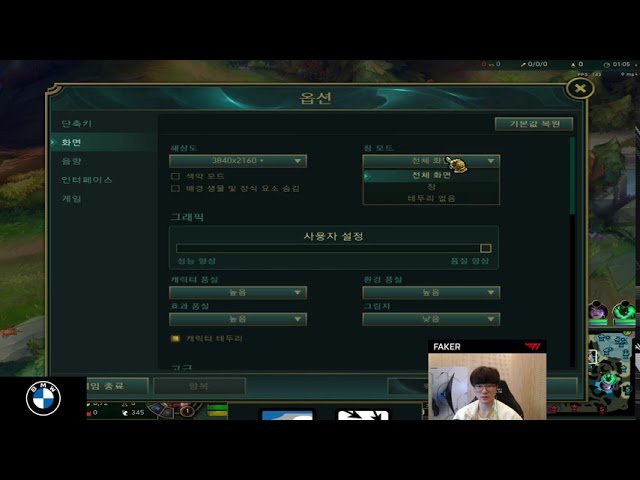
Video Settings: Balancing Visuals and Performance
Faker's video settings prioritize performance while maintaining decent visual quality.
- Key Settings: Fullscreen mode, high character quality, high effects quality, high environment quality, and low shadows.
- Shadows Off: Disabling shadows is a common practice among professional players as they can be distracting and resource-intensive.
Fine-Tuning Keybinds: Optimizing Control
Faker's keybinds are fairly standard, but they demonstrate the importance of having comfortable and accessible controls.
- Standard Setup: Abilities on QWER, summoner spells on DF, and item slots easily accessible.
- Customization: Experiment with different keybinds to find what works best for your hand size and playstyle. Consider using side mouse buttons for items or abilities.
- Camera Movement: Faker's camera move speed (Mouse & Keyboard) is 65.
Camera Control Preferences
His camera control preferences may vary when using his mouse alone. Regardless, the value is on the higher end of the spectrum.
- Camera Move Speed: Faster settings are good for moving around the map, but may be harder to control for more niche scenarios.
From Faker's Settings to Your Own: A Practical Playbook
Trying to replicate Faker's settings exactly might not be the best approach. Instead, use them as a starting point to discover what works best for you. Here's a practical guide:
- Start with a Baseline: Begin with a DPI between 800 and 1600 and a Windows sensitivity of 6.
- Adjust In-Game Sensitivity: Fine-tune your in-game sensitivity until you can comfortably make precise movements.
- Calculate Your eDPI: Calculate your resulting eDPI to compare with other players' settings.
- Experiment with Video Settings: Start with low shadows and adjust other video settings based on your computer's performance.
- Customize Keybinds: Optimize keybinds for easy access to abilities, summoner spells, and items.
- Practice and Refine: Play several games with your new settings and make small adjustments as needed.
- Use a Mousepad: A mousepad is crucial for performing well. A medium glide with stiched edges offers the most comfort and control.
- Use a Good Monitor: A high refresh rate is crucial. 144Hz or higher will do the trick.
- Consider your mouse shape: A properly sized mouse relative to your hand will help with your overall performance.
Quick Answers: Common Questions About Faker's Settings
- Does Faker actually use these exact settings all the time? While these are his reported settings, pros may tweak them slightly depending on the game, champion, or personal preference. No one truly knows what he is using at at any exact point in time.
- Will copying Faker's settings instantly make me a better player? No. Settings are just one piece of the puzzle. Practice, game knowledge, and decision-making are far more important.
- Why does Faker use 1920x1080 resolution? It's a balance between visual clarity and performance. 1080p allows for high frame rates, which is crucial for competitive play.
- Is a high polling rate really necessary? A 1000 Hz polling rate is generally recommended for gaming as it minimizes input lag.
- I have a different mouse/keyboard. Can I still benefit from this guide? Absolutely. The principles of DPI, sensitivity, and keybind optimization apply to all peripherals.
Actionable Close: Finding Your Perfect Configuration
Understanding Faker League settings is a great starting point, but the real value lies in finding what works best for you. Use this information as a guide, experiment with different options, and prioritize comfort and accuracy. By fine-tuning your setup, you can optimize your gameplay.